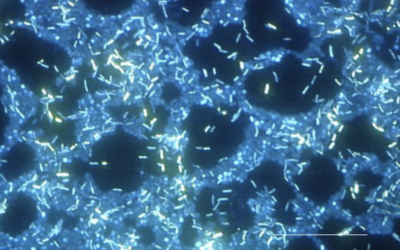
When you’re being tested for NTM lung disease, one of the first results you may hear about is something called an AFB smear.
A little background …
Mycobacteria were first described in the late 1800s. Scientists noticed they behaved differently from most bacteria. They resisted staining in the laboratory, which made them difficult to see under a microscope.
The reason?
Mycobacteria have a very thick, waxy cell wall made up largely of lipids (fats). This unusual coating makes them:
Resistant to acid and alcohol
More resistant to disinfectants like chlorine
Slower growing than many other bacteria
However, because of that waxy coating of fats, they hold onto special red or pink dyes, even after being washed with acid. This is called acid-fast staining.
That’s where the term AFB comes from – Acid Fast Bacilli.
What is an AFB smear?
An AFB smear will be performed on your sputum sample. In simple terms:
First, a small amount of your sputum is spread onto a glass slide,
It is treated with special stains,
Then, a lab technician looks at it under a microscope.
If acid-fast bacilli are seen, the smear is reported as positive.
If none are seen, it is negative.
Why does the smear result come back so quickly?
Because the lab is simply looking for bacteria under the microscope. There is no need to wait for bacteria to grow. Results often come back within a few days.
What does the smear result actually tell us?
An AFB smear tells us about the bacterial load – in other words, how many acid-fast organisms are present in our sputum samples.
If many organisms are seen, the smear may be reported as:
1+
2+
3+
The higher the number, the more acid fast organisms can be seen immediately under the microscope.
This does NOT tell you:
Which species of mycobacteria you have.
Whether the organisms are dead or alive.
Which antibiotics will work.
It simply tells you and your doctor whether there are enough organisms present to be seen immediately.
In my imagination, a smear is a bit like looking at the night sky. If there are lots of stars, you see them easily. If there are only a few, they can be hard to spot. I might not see any at all – or I would have to use my longest camera lens to see them.
OK, so what is a culture?
A culture is different.
Instead of just looking at the bacteria, the lab tries to grow them from your sputum sample.
Your sputum is placed into special media that encourages mycobacteria to multiply. Most NTM bacteria grow slowly, so this can take weeks – sometimes 8 weeks or more.
Why do I need to wait so long?
Because taking the time to grow a culture allows the lab to:
Confirm the organisms they saw are in fact alive
Identify the exact species of Mycobacterium
Perform susceptibility testing to see which antibiotics might work best against the bacteria, and which won’t.
The culture is the definitive test.
Why might a smear be negative but a culture positive?
This has happened to me – and I was told it is common with NTM.
Smears only detect bacteria when there are enough present to be visible under a microscope. If the bacterial load is very, very low, the smear can be negative – nothing is seen – but the culture might still grow organisms weeks later.
That’s why doctors rely on culture results, not a smear alone, to properly diagnose NTM lung disease.
So, why do smear results matter?
Even though the culture gives more detailed information, smear results are still important because:
They give early clues
They help estimate bacterial load
They can be used to monitor your response to treatment
Waiting for culture results can feel endless. I know that feeling. I’m waiting right now.
The smear was the first hint. It was good news for me – but it’s only part of the story. I’m waiting to make sure nothing grows this time.
The culture will take its time – it always does.
In the meantime, we keep living. We keep breathing. We keep showing up for each other.
That, too, is part of the story.
One step at a time.
Arohanui
Mary